Big Wilson, Tasmanian (Tin) Project
The Tasmanian Tin Project comprises two exploration licence applications (ELA 22/2025 and ELA 23/2025) covering approximately 203 km2 in north-western Tasmania near the town of Rosebery. The tenure is situated adjacent to two of Australia’s most significant tin assets:
- Renison Bell - operating tin mine (Metals X/Yunnan Tin JV), ~292,000t contained Sn
- Mt Lindsay - undeveloped tin-tungsten deposit (Critica Ltd), ~81,000t Sn and ~32,000t WO3
The licence area covers a historically productive mining district with well-maintained road access and has been the subject of historical mining and limited modern exploration across multiple mineralisation styles typical of the Tasmanian West Coast tin province.
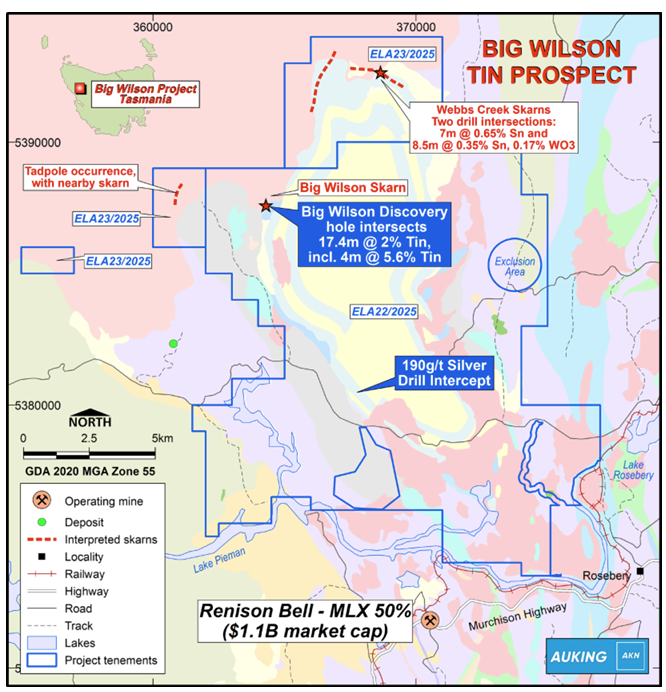
Location of the Tasmanian Tin Project, north-western Tasmania.
Key Prospects
Big Wilson is the headline prospect, where 13 diamond holes have tested a skarn and greisen system at the contact of the Devonian Meredith Granite and Palaeozoic limestone. A 1,100m soil anomaly coincident with the marble contact remains open along strike. Highlight drill results include:
- 17.4m @ 2.0% Sn including 4m @ 5.6% Sn from 209.6m (BW001)
- 42m @ 0.32% Sn including 8m @ 0.77% Sn from 211m (BW003A)
- 21m @ 0.25% Sn including 13m @ 0.32% Sn from 58m (BW008)
Merton Hill hosts polymetallic Sn-Pb-Zn-Ag mineralisation in fault-controlled veins, tested by Renison Ltd (7 holes, 1979–1983) and Venture Minerals (3 holes, 2012). Results include 3m @ 0.19% Sn, 1.27% Pb, 3.68% Zn and 53 g/t Ag, with high-grade silver intercepts of up to 190 g/t Ag at depth.
Laurel Creek (Webbs Creek) features extensive tin and tungsten bearing magnetite skarns confirmed by five shallow diamond holes (Gold Fields, 1983–84), highlighted by 7m @ 0.65% Sn and 8.5m @ 0.35% Sn with associated WO3.
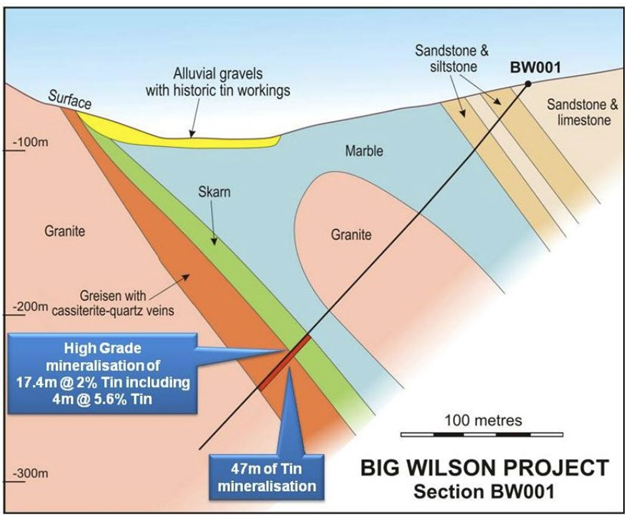
Big Wilson discovery hole (BW001) cross-section.
Exploration Upside
Modern exploration across the licence area has been limited despite the confirmed presence of mineralised systems at multiple prospects and extensive alluvial tin workings dating from the late 1800s to early 1900s. A 2019 airborne VTEM survey over the western portion provides additional targeting data. With LME tin prices around US$55,000/t and very few new tin projects globally, the project offers high-grade discovery potential in a well-understood geological setting with established infrastructure.
Cautionary Note
Historical exploration results referenced above have not been reported in accordance with the JORC Code 2012. A Competent Person has not completed sufficient work to disclose these results under JORC 2012. It is possible that following further evaluation, confidence in prior results may be reduced. AuKing has not independently validated the former owners’ exploration results and is not to be regarded as reporting, adopting, or endorsing those results.